 As my neighbor came out of her house last weekend, white wedding dress complete with beading, tulle, and satin flouncing around her, it reminded me that wedding dresses have not always been white. Wearing white (for western brides) did not become fashionable until Queen Victoria donned one (she was probably not amused). This flamboyant gown made people note her status, and soon after brides began to copy her. It was certainly not a virtuous color, and was seen as a symbol of wealth since you would not have to wear the dress again.
In ancient times, here are some of the customs that were followed:
- Roman women wore a dress similar to the robes of Juno, goddess of marriage. They were modestly draped and would cover their heads with a red square of cloth to appear pale and statuesque.
- Grecian women would wear long, elegant dresses (like the peplos). Their dresses were closed with two clasps, and the more expensive and ornate the clasps, the more wealthy the family. They covered their heads in gold to symbolize virginity, joy and happiness (the color of the sun).
- Russian women wore red to symbolize joy and beauty. The dresses were similar to today's sundresses and they wore their hair plaited with ribbon.
Today many cultures continue to wear colors other than white (Asian cultures still prefer bright colors), and with a move towards non-traditional marriage, weddings and lifestyles, perhaps in the future of western weddings, we may begin to see a rainbow of possibilities.
 For anyone passionate about Greek mythology, prepare for a fun romp with Deus Ex Machina. Stewart Dunk, a socially inept young man under the thumb of his overbearing (and lusty) mother, finds out that his new neighbors are none other than a group of the Greek gods. Ares, Hermes, Aphrodite, Athena and Medusa all play their respective parts and Aragon has clearly done her research (by stating Medusa's Libyan ancestry, for example). However, the Greek mythology scholar should also prepare for a hearty dose of suspension of disbelief as Athena and Hermes become quite an item through Aphrodite's meddling and manage to produce divine offspring. Full of a sense of what would happen if you let Aphrodite handle the cooking (fish soup, anyone?) and Ares handle home redecorating (provided you don't need any walls left), a mythology lover will have a lot of laughs along the way.
The writing itself, however, often speeds along at too fast a clip (much of the book is dialogue and slapstick comedy), and could have benefited from a better sense of pacing. But if you manage to lend the author some patience, you will find a gem of a story and a rip-roaring good time.
 One of the things I enjoy bringing back with me from Egypt is recipes. Unfortunately, often I travel to countries where it is difficult to purchase a cookbook in English. The best Egyptian cookbooks are written in Arabic, and the small vegetarian Egyptian cookbook I managed to bring back is full of odd spellings, enough so that I am determined to try the recipes a few times before sharing.
With that said, people have asked me what the food is like in Egypt. Needless to say, I was a very happy and full vegetarian on the entire trip. Falafel that melted in my mouth, hummus that could be prepared at least a dozen ways, and koshari, a mix of pasta, lentils and crispy onions in a tomato sauce were all my downfall.
Falafel, or Taameya in Egypt, is ground up chickpeas or fava beans mixed with spices and fried until they are a golden brown. These morsels are delicious on their own, or in a pita with chopped tomato, cucumber and sometimes hummus. Most American grocery stores sell falafel mix in a box which requires a few wet ingredients, shaping them into balls and frying them. Like many other good things in life, an entire article is devoted to Falafel at Wikipedia.
However, if you're up for making them from scratch, head over to Cooks.com for a falafel recipe that's sure to be a winner. If you're up for a real adventure, head over to Lizabetti's blog "Cool Stuff You Can Do" , which contains pictures and a step-by-step guide for a delectable Egyptian falafel feast.
Picture courtesy of the Falafel article at Wikipedia.org
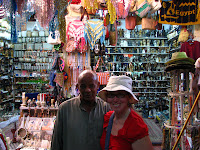 Our final day in Egypt landed us in Cairo where we had a couple of choices: visit the City Stars Mall, the largest mall in Egypt (though it would not surprise me to learn that it's the largest in the Middle East), or venture to the labyrinthine Khan el Khalili Market. Of course, we had a full day and so we opted for both. We had only spent one hour shopping previously in the Aswan market (picture on left).
The City Stars Mall is a short distance from Le Meridien Heliopolis, where we stayed for our final night in Egypt. The bottom three floors are for parking, and the other seven or eight are for shopping and eating. Large glass elevators plunge through the center of the mall, and staircases wind up as far as the eye can see. This mall takes itself seriously - like the temples and tombs we visited, we were treated to a bag security check upon entering and signs posted everywhere said to hang on to your receipts for security purposes. Most of the stores and signs are either in English or in English and Arabic, though we found that many of the people running the stores did not speak English. A small section in this mall is devoted to the Khal el Khalili market, and where we hoped for no hassle shopping (the regular shops behaved like a western shopping mall), the shopkeepers in this section of the mall behaved only a little less forward than those at the Khal el Khalili market themselves. Restaurants and cafes are everywhere - whatever your fancy, whether it be wes tern or oriental style food, you will find it here. We chose to eat at Abou el Sid, a traditional Oriental style restaurant where the entire table was moved out for us as we sat down. Not knowing any better, we ordered enough food to feed a small army, but the falafel and hummus once again were mouth-watering. We also had an opportunity to try koshari, a traditional vegetarian Egyptian dish consisting of rice, difference pastas, lentils and crispy onions topped with a delightful spiced tomato sauce.
The actual Khan el Khalili market was a completely different experience. Wall-to-wall tourists and Egyptians strolled through the markets, some carrying large packages of unknown goods on their heads, or on their backs shouting "Excuse me" in multiple languages. There were no landmarks, no way to navigate other than to lose ourselves in the labyrinthine alleys and shops. Different areas of the market appeared to specialize in different items: clothes, jewelry, gaudy tourist items, sleepwear, towels & linens, and kitchen appliances. The most terrifying section was the fireworks vendors - I couldn't help but wonder what would happen if one of them became lit.
For fun, I took inventory of the most colorful sayings that were shouted out to us:
"You are a queen!" (Well, all women like complements!)
"Hey Shakira!" (Must be my blonde hair, but I'm not Spanish...)
"No hassles!" (Interestingly enough, this never meant no hassles.)
"Everything is free!" (I never had the courage to find out what this meant.)
"I have what you want!" (I'm sure you do!)
"You are a very lucky man!" (To my husband - also nice to hear!)
Interestingly enough, no one seemed to think I was American. All shopkeepers assumed I was British (by quoting in British pounds) and then Italian (apparently I speak too much with my hands). This happened in our brief shopping stint in Aswan as well, however here, our favorite phrase became "Trust me, I'm a Nubian!"
Welcome drinks were almost always offered as a the beginning bartering phase. Most often this consisted of hibiscus tea, a safe drink due to the fact that they boil the leaves first. Once the bartering began, the research we did prior to our trip gave us the opinion that we should expect to buy the items for 20-30% of the initial price, and this tended to be accurate, although sometimes vendors refused to barter lower than their initial price due to us being tourists. We did have fun, however, despite a cat knocking over a wooden ladder that crashed down a foot in front of me and a hashish pipe that fell over behind me starting a fire. When I asked the vendor I was bartering with if fires happened often he shrugged and said "No. Must be a dragon."
On that humorous note, I concluded a wonderful trip to Egypt, and if someone asked again, I would do it again in a minute.
 The second book in her YA Darkest Power series, The Awakening picks up where The Summoning left off, without a lot of backstory. Betrayed by Chloe's Aunt Lareun, she and her friends have been recaptured by The Edison Group. The group genetically experiments on supernatural teenagers, and it is during this stay that they learn that they are failed genetic experiments with powers that may or may not be able to be controlled. Through a series of teenage relationship posturing and bickering, including another betrayal and an unlikely friend, Choe escapes to be reunited with her friends Derek and Simon. This second book, obviously a middle book in the series, is their attempt to reach a safe haven in the boys' fathers' friend, Andrew.
One of the more unique qualities of The Darkest Powers series, as well as Armstrong's adult series Women of the Otherworld, is her ability to humanize the supernatural, which also extends to demons and necromancers. As a young necromancer, it would be easy to discount Chloe as a freak of nature, but Armstrong does a remarkable job of pulling the reader into Chloe's head and letting the reader feel her anguish and fear as she comes to grips with her powers.
If you are interested in the paranormal/fantasy genres, pick up a copy of The Summoning, Armsrong's first book in this series. After reading two of them, the series promises to be a fun romp through supernatural-dom.
 Our first trip into Aswan was to a granite quarry. In the midst of sparkling pink and gray granite boulders lies the Unfinished Obelisk. Worked on during Hatshepsut's reign, it was later abandoned due to a large crack running down it lengthwise. I couldn't help but wonder what happened to the workers once the crack was discovered... Large green rocks, the size of an ancient cannonball, stand out against the pink granite and seem to lie everywhere like discarded ancient . These green rocks were once the tools used to cut out the obelisks. Five times the hardness of granite, they were banged against small indentations at regular intervals to dig the obelisk out of its stone coffin. Although a long time wasn't needed here, walking amongst the granite in 110 Fahrenheit weather and holding one of these green rocks gave a great understanding of the strength and stamina needed to create one of these beautiful sculptures of antiquity.
The Aswan Dam was our next stop. Created as a joint effort between Egypt and Russia, the Aswan Dam's purpose was to stop the annual flooding of the Nile. A memorial to the joint effort overlooks the dam nearby. On the other side of the dam are the famed crocodiles and hippos who now live happily in Nasser Lake, the largest man-made lake in the world. Standing on the dam gives a beautiful vista of both sides of the Nile. Though zoom photography is expressly forbidden, we managed to take a few beautiful shots of the fertile Nile Valley from above.
In order to get to the Temple of Philae, Isis's sacred cult center, we had to board a motor boat. Watching the chaos of the boats reminded me of Rome, and I happily boarded the boat to watch the men take a moment to physically force the other boats away so we could back out. Being on the boat gave us a moment to wiggle our fingers in the Nile, as well as to be close to the great egrets and herons that graced its waters. The Temple of Philae is not in its original location; it had to be cut into thousands of pieces and moved due to flooding. Unless you look carefully, however, you wo uld never notice amidst the defacing done by the Christians who once used this temple as a church. Vertical scratches appear on the walls, a testament to the pilgrims of Isis who came here to claim a piece of the temple for themselves. A lone stone altar lies in the main sanctuary and I could feel the power radiating off of a stone that has existed for centuries. This temple was the last used temple of Ancient Egyptian Religion, and it seemed appropriate that it was dedicated to Isis. Perched on the rocks, the location seems magical and serene, a perfect ending point to our temple touring in Egypt.
Last, but not least, thoughts on the Nile and shopping in Egypt.
 I've always been a fan of cartography in all its forms, especially the intrinsic beauty in old globes around the world. This fascination once led me to the only globe museum in the world. Located in Vienna, Austria, it has over two hundred globes on display as well as a couple of hundred other assorted objects related to globes (armillar spheres, planetaria, and telluria). The main focus, however, is the joint creation of terrestrial and celestial globes made before 1850. In 2005, the museum moved to the Palais Mollard in Herrengasse. The price is only five euros, and if you are interested in ancient map-making, the museum is not to be missed. Sadly, however, no photos are allowed. More information on the Globe Museum can be found at their website.
Speaking of maps, the creator of the Strange Maps Blog, has a sit, Strange Maps, Globe Museum, Austria, Vienna, The Map Room, Where to Goplethora of assorted maps from around the world. From maps delineating how many people in Ireland speak English, to maps of shipwrecks along the Atlantic Ocean coastline, there is a map for every occasion here. Visit the Strange Maps Blog here.


 As my neighbor came out of her house last weekend, white wedding dress complete with beading, tulle, and satin flouncing around her, it reminded me that wedding dresses have not always been white. Wearing white (for western brides) did not become fashionable until Queen Victoria donned one (she was probably not amused). This flamboyant gown made people note her status, and soon after brides began to copy her. It was certainly not a virtuous color, and was seen as a symbol of wealth since you would not have to wear the dress again.


